Stick vs Zombies: Platformer
- 4.4
- Rating
- 50.00M
- Installs
- Free
- Price
 Analysis by App-foxy
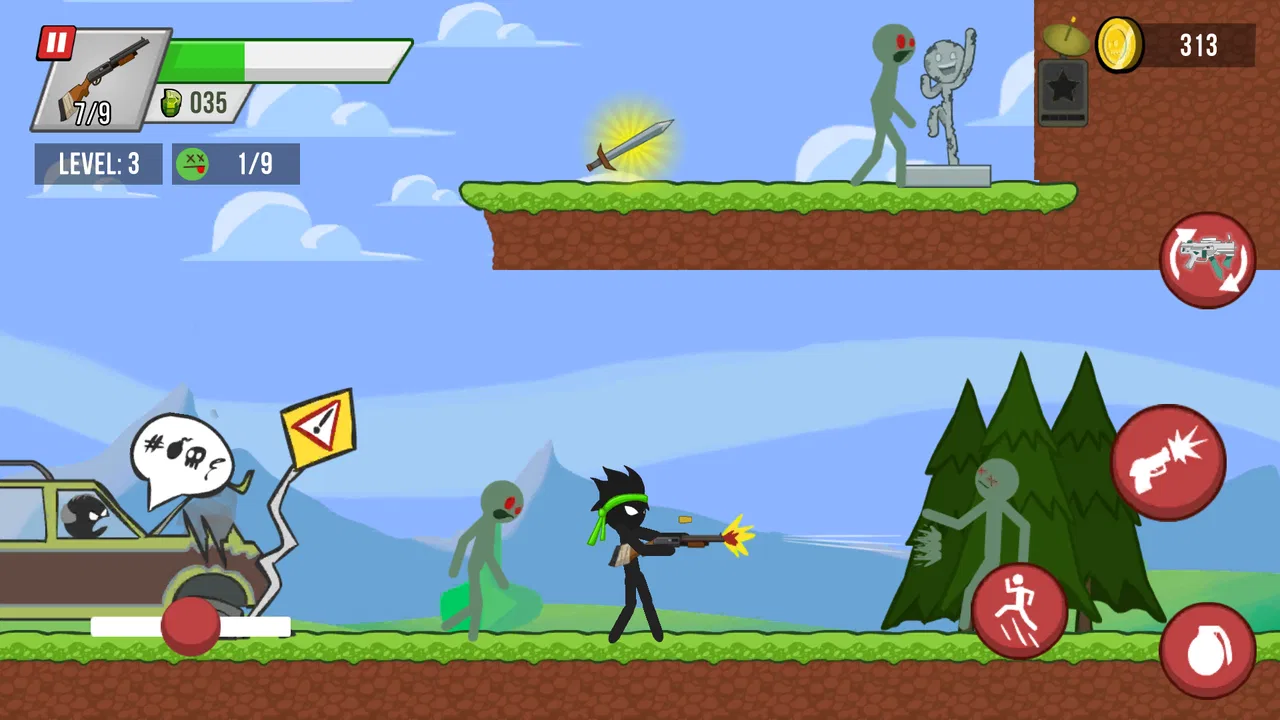
I spent time with Stick vs Zombies: Platformer as the sort of game that can quietly become a shared-device favorite. It is quick to understand, easy to pick up for a short session, and built around the satisfying combination of stick-figure combat, movement, and zombie clearing. The basic appeal is immediate: run, jump, fight, use weapons, and keep moving through action-platforming stages. What makes it more interesting than a simple tap-to-attack game is the way parkour movement and combo timing affect how well a run goes.
That combination makes it a practical choice for a household tablet or a phone passed between people. One person can play for a few minutes, hand the device over, and the next player can start without needing a long explanation. At the same time, I would not treat it as a completely consequence-free game for every family situation. The action is cartoonish rather than realistic, but it still revolves around fighting zombies, and the presence of optional purchases means the person managing a shared device should set clear expectations before anyone plays.
What the game feels like in everyday use
My first impression was that the game works best when I approach each level as a movement challenge rather than as a basic zombie shooter. The stick-figure presentation keeps the screen readable, while the platforming gives the action a useful rhythm. I am not simply standing in one place waiting for enemies to appear. I have to think about where I am landing, when to attack, and how to keep momentum instead of letting a group of zombies surround me.
You May Also Like

 Blood Strike: 2.5 Anniversary
Blood Strike’s Loadouts Turn Every Drop Into a Tactical Gamble
A close look at Blood Strike’s custom loadouts: how fast access to signature weapons reshapes its battle royale rhythm, rewards preparation, and narrows the gap between fights.

 Pandora - Music & Podcasts
Pandora’s Music Is Easy to Start, but Harder to Recover
Pandora’s strength is its low-effort path from a seed to a station. Its weak spot is how much confidence it asks you to place in connection, setup, and quiet recovery.

 8 Ball Pool
 Is Built on Rivalries, Rematches, and Routine
A close look at the rivalries, rematches, shared routines, and unanswered safety questions that turn a quick pool match into a persistent mobile community.

 Samsung Music
’s Quiet Strength Is Playing What You Already Own
Its reach comes less from spectacle than from dependable access to a personal library. That simplicity is both the app’s strongest retention engine and its ceiling.

 AccuWeather: Weather Radar
AccuWeather Review: A Quick, Clear Forecast for Everyday Decisions
For everyday plans, the best forecast is the one you can understand quickly. AccuWeather makes rain timing, radar, and local conditions easy to act on, with a few trade-offs.

 Hill Climb Racing
Why Hill Climb Racing Still Turns Crashes Into One More Run
A tiny car, a bumpy hill and one more upgrade: Hill Climb Racing keeps resurfacing because its simple chaos makes every near-miss feel personal.
More From Our News Desk



That makes it particularly suitable for short breaks. If I have only a few minutes while waiting for an appointment or taking a break from another task, I can get into the action quickly. It does not ask me to learn a large cast of characters or understand a complicated story before the controls become useful. The focus is on the physical feel of moving through danger and making a clean sequence of attacks.
The game comes from Aurecas Games and sits firmly in the action category. It is free to install, with optional purchases ranging from $0.99 to $104.99 per item. That pricing range is worth noticing when the game is used on a shared phone. Even when purchases are not necessary to enjoy the core action, a child or another household member may not understand the difference between a free download and a purchase option that appears during play.
For a personal device, that is a simple matter of knowing my own habits. For a family device, it becomes part of the setup conversation. I would decide in advance whether purchases are off limits, whether the device owner must approve anything, and whether the game is being used as a personal save space or as a casual activity that anyone may open. The game itself does not solve those household boundaries, so the people sharing the device need to do that work.
Why the movement matters more than the premise
The zombie theme is familiar, but the platforming is what gives this particular game its identity. I found that rushing directly toward every enemy is usually less satisfying than treating the environment as part of the fight. A jump is not only a way to cross a gap; it can also change the angle and timing of an attack. When I combine movement with strikes instead of separating the two, the action feels more controlled.
A useful habit is to avoid pressing every attack as soon as it becomes available. I get better results when I watch the spacing between my character and the nearest threat, then use a jump or repositioning move before committing to a combo. This is one of the less obvious lessons of the game: a flashy sequence is only useful if it leaves me in a safe position for the next group. New players may focus on the number of hits, but survival often depends on where the final hit places them.
Weapons add another layer to that decision-making. I do not see them as a reason to abandon normal movement. They are more useful when I treat them as tools for changing the pace of an encounter. If several enemies are closing in, a weapon can create breathing room; if the path is already clear, saving it may be more sensible than spending it immediately. That small distinction helps the combat feel less like random button pressing.
This is also where the game can expose differences between players using the same device. Someone experienced with action games may naturally look for timing and positioning, while a younger or less experienced player may simply hold the attack button and move forward. I would not correct every mistake while sharing the game. A better approach is to point out one practical idea at a time, such as jumping before attacking a crowded group, so the advice remains useful instead of turning a short play session into a lesson.
Shared-device play without turning it into a competition
In a household scenario, I would use this game in turns rather than expecting several people to play together on one device. The design is suited to a single player holding the screen, so coordination happens around the device rather than inside a multiplayer match. That can be a strength: nobody needs to arrange a simultaneous session, and a person can play while others watch or wait.
A simple routine works well. One player takes a short turn, explains what they discovered, and passes the device on. The next person can try the same section with that information, but the focus should stay on improving personal control rather than proving who is best. Because the game emphasizes action and quick reactions, a younger player may need more attempts than an experienced adult. Giving each person a fixed amount of time is fairer than handing over the device only after a successful run.
I would also keep the game separate from important household tasks. It is easy for a short action game to become “one more attempt,” especially when a player is close to handling a difficult sequence. On a shared tablet, agreeing on a stopping point before starting is more effective than interrupting after every failure. For example, players can stop after a completed section or after a timer ends. That arrangement is not a feature of the game; it is simply a practical way to prevent the device from becoming a source of arguments.
Another useful boundary is deciding whose progress matters. If everyone opens the same game on the same device, people may assume that one run belongs to everyone. That can be fine for casual use, but it can also create frustration if one person changes the position another person wanted to continue from. I would agree that the game is either a shared experiment or a personal activity for one main player. If several people want individual progress, separate device profiles or separate arrangements outside the game may be more suitable, provided the device supports them.
Setup questions to settle before the first session
The technical entry point is fairly approachable. The game was released on August 31, 2018, and the current version is 1.6.3. It requires Android 7.0 or later, so the main compatibility question is whether an older Android phone or tablet meets that requirement. I would check that before planning to install it on a spare household device, especially if that device has been sitting unused for several years.
The game is free, which lowers the barrier to trying it, but “free” should not be confused with “without spending decisions.” The optional purchase range is wide enough that I would not leave a shared device unattended with a payment method available. In a household, the safest approach is to make the purchase rule explicit: either nobody buys anything, or every purchase requires the device owner’s permission. This is particularly important when a child sees an attractive weapon or progression option and assumes that tapping a button is part of normal play.
I also recommend deciding whether the game is appropriate for the people who will use the device. Its content rating is Everyone, and the presentation uses stylized stick figures rather than realistic characters. Still, the central activity is combat against zombies. Some children will find that harmless and funny, while others may dislike the repeated fighting or become unsettled by the theme. The age label is helpful, but I would still make the final decision based on the individual child’s comfort and maturity.
For a shared device, I would start with a short supervised session. That gives everyone a chance to see the tone, understand the controls, and notice whether the action is exciting or overwhelming. It also reveals whether a player is more interested in the movement, the weapons, or simply watching someone else play. That first session is a better guide than assuming every person will react to the game in the same way.
Age, trust, and the kind of supervision that makes sense
The Everyone rating makes the game easier to consider for a broad household audience, but it does not remove the need for judgment. The important distinction here is between visual intensity and behavioral intensity. The visuals are simple and stylized, yet the player is still rewarded for quick attacks, combos, and pushing through groups of enemies. A child who becomes frustrated by repeated failure may need help taking breaks, even if the imagery itself is not disturbing.
I would be comfortable introducing it to a child who already understands that game purchases require permission and that a shared device is not personal property. I would be more cautious with a child who taps through prompts without reading them or becomes upset when another person takes a turn. In that case, the issue is less about the zombies and more about whether the child can handle the game’s pace and the household rules surrounding it.
Trust also matters when weapons and progression are involved. I would explain that using a weapon inside the game is different from buying something through the device, and that the two decisions should not be confused. This may sound obvious to an adult, but it is exactly the kind of distinction that prevents accidental spending or misunderstandings on a shared phone.
There is no need to hover over every moment of play. Once the player understands the content and the purchase boundary, occasional check-ins are usually enough. I prefer asking what they are trying to do next rather than watching only for mistakes. That encourages them to describe the movement and combat choices, which can reveal whether they understand the game or are simply repeating inputs without knowing why they work.
Where it stands beside other action games
Compared with a conventional mobile shooter, this game feels more focused on close-range timing and platform navigation than on aiming across a large arena. That makes it a better fit for someone who enjoys compact action sequences, jumps, and combos. If I want a slower game built around planning, collecting, or exploration, I would choose something else. If I want a game that gets to physical action quickly, this one has a clearer advantage.
It also differs from many endless runners. The movement can be fast, but the objective is not simply to survive by avoiding obstacles. Attacking, choosing a route through platforms, and managing the distance from enemies are central to the experience. Someone who enjoys runners but wants more direct control over combat may find this a natural step toward action-platformers.
On the other hand, players looking for a deep story, extensive character development, or a highly social experience should set their expectations differently. The appeal here is the playable loop: movement, fighting, combos, and weapons against zombie threats. A larger console-style adventure may offer more variety and narrative context, while this game is more convenient when I want a compact session on a phone.
The offline action-platforming focus is another practical advantage for certain situations. I can see it working well during travel or in places where I do not want to depend on a live match or a constant connection. That makes it more flexible than games whose main attraction is online competition. Still, offline convenience does not automatically make it a good fit for every trip; the quick-action format may be tiring if I am looking for something calm during a long journey.
Three ways to get more from the combat
My first tip is to learn the relationship between landing position and attack range. Instead of thinking of a jump as a separate movement, I treat the landing as the start of the next decision. If I land too close to a crowd, the combo may leave me surrounded. If I land with a little space, I have more options. Practicing that spacing is more valuable than chasing impressive-looking attacks.
Second, I would use weapons to solve a specific problem rather than activate them whenever they appear. A weapon is most useful when it changes an encounter that ordinary strikes are not handling comfortably. Saving one for a crowded passage or an awkward approach can make the next sequence less chaotic. This also gives a new player a simple question to ask: “What problem am I trying to solve with this?”
Third, I would separate experimentation from progress. During a personal session, it is worth trying a different route, attack order, or jump timing even if it causes a failure. During a shared turn, however, a player may prefer to repeat a reliable approach so the next person is not left with a confusing situation. Alternating those two styles—practice when alone, consistency when sharing—helps the game work better in a household.
These habits are useful because they address the game’s real friction. The challenge is not only defeating zombies; it is maintaining control when movement, attacks, and enemy spacing collide. Players who dislike learning through repeated attempts may find that frustrating. Players who enjoy gradually improving a sequence will probably appreciate that the same basic controls can produce better results with practice.
Who should choose it, and who should skip it
I would recommend it to someone who wants a free action game that can be played in short bursts, especially if they like stick-figure visuals, platforming, and direct combat. It is also a sensible candidate for a shared household device when the adults establish purchase and turn-taking rules first. The broad age rating and simple presentation make it approachable, while the movement gives experienced players something to refine.
I would skip it if my main goal were a peaceful game, a rich narrative, or a cooperative experience where several household members play together at the same time. I would also look elsewhere if I strongly disliked repeated combat against zombies, even in a cartoon-like style. The game’s simplicity is part of its charm, but it also means that someone seeking a large world or elaborate long-term systems may run out of reasons to return.
The game has attracted over 50 million installs, with a 4.4 average from around 158 thousand ratings and about 2.1 thousand written reviews. Those figures suggest that its straightforward action has connected with a large audience, but popularity does not change the personal fit question. A person who enjoys fast platform combat may understand the appeal immediately, while someone who wants slower strategy may find the same design repetitive.
My household verdict
After using it as both a personal game and a possible shared-device activity, I see its strongest quality in its clarity. I know what I am doing within moments: move through the platforming space, fight the zombie groups, use combos thoughtfully, and decide when a weapon is worth spending. That clarity makes it easy to recommend for a quick break and easy to explain to another player.
My reservations are equally practical. The action can encourage “just one more try,” which is not ideal when several people need the same phone. Optional purchases require an adult-defined boundary, and the Everyone rating should still be paired with a quick personal check of how each child responds to zombie combat. These are manageable concerns, but ignoring them can turn a simple game into a household annoyance.
For me, the best arrangement is a shared tablet with short, agreed turns, no unapproved purchases, and enough freedom for each player to discover the movement system. I would introduce it as a compact action game rather than promise a deep adventure. If that description matches what you or your family wants, Stick vs Zombies: Platformer is an enjoyable free option from Aurecas Games. Its strongest audience is anyone who values immediate combat, platforming practice, and offline-friendly action more than story or multiplayer depth.
FAQs for Stick vs Zombies: Platformer
01What is Stick vs Zombies: Platformer about?
Stick vs Zombies: Platformer is an action-packed game where players control a stick figure navigating through levels filled with zombies. The goal is to survive waves of undead while using various weapons and power-ups. The game combines platforming elements with strategic combat, offering a unique and engaging experience for fans of both genres.
02What are the system requirements for Stick vs Zombies: Platformer?
Stick vs Zombies: Platformer requires Android 5.0 or iOS 10.0 and above. It runs smoothly on most modern devices with at least 2GB of RAM. Ensure you have sufficient storage space available, as the game file is approximately 200MB. A stable internet connection is recommended for seamless updates and multiplayer features.
03Are there in-app purchases in Stick vs Zombies: Platformer?
Yes, Stick vs Zombies: Platformer offers in-app purchases. Players can buy coins and special items to enhance their gameplay experience. These purchases can help unlock new weapons, skins, and abilities faster. However, all content can also be unlocked through regular gameplay, ensuring a balanced experience for all players.
04Is Stick vs Zombies: Platformer suitable for children?
Stick vs Zombies: Platformer is rated for ages 12 and up due to mild cartoon violence. The game features stick figures and zombies, and while the action is intense, it's depicted in a humorous and non-gory way. Parents should consider this rating and determine if it's appropriate for their children based on individual sensitivities.
05Does Stick vs Zombies: Platformer have a multiplayer mode?
Yes, Stick vs Zombies: Platformer features a multiplayer mode where players can team up with friends or compete against others online. This mode includes cooperative missions and competitive challenges, adding an exciting social element to the game. Players can also join clans and participate in special events for additional rewards.
Pros
- Intuitive controls make gameplay smooth.
- Vibrant graphics enhance visual appeal.
- Challenging levels keep players engaged.
- Frequent updates with new content.
- Offline mode available for play anywhere.
Cons
- In-app purchases can be pricey.
- Occasional ads disrupt gameplay.
- Limited character customization options.
- Some levels feel repetitive over time.
- Requires a lot of storage space.

Stick vs Zombies: Platformer
Gallery